
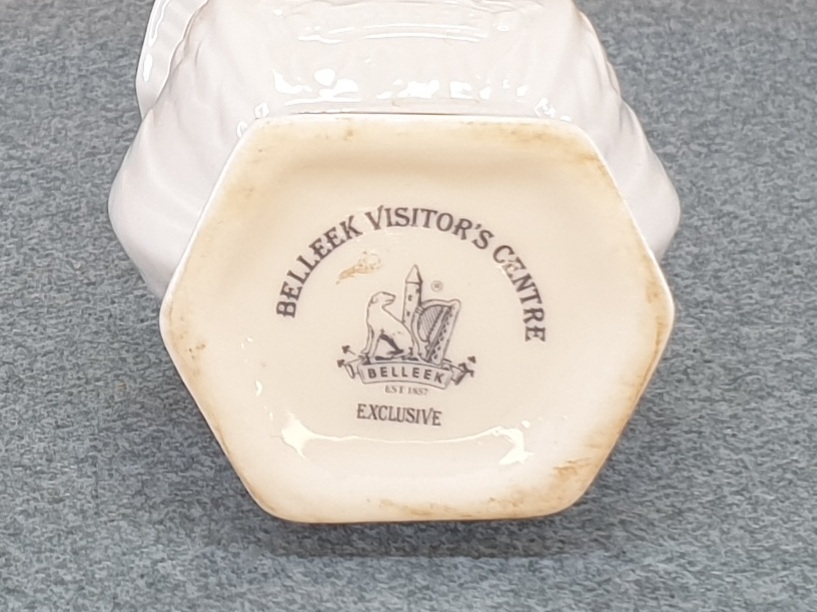
About Belleek Pottery
Belleek Pottery was established in 1857 in the village of Belleek, County Fermanagh, Ireland. The business was founded by landowner John Caldwell Bloomfield, architect Robert Williams Armstrong and Dublin merchant David McBirney. Bloomfield had commissioned a geological survey of his Castlecaldwell estate, which identified deposits of feldspar, kaolin and other minerals suitable for ceramic production.
The location beside the River Erne provided a source of water power for the pottery, while the founders brought together the land, expertise and financial backing needed to establish the business. The foundation stone was laid in November 1858, and production began around 1863. Initially, the factory concentrated on practical earthenware, including tableware, washstands, hospital ware and other domestic goods.
One of the founders’ ambitions was to develop a fine porcelain using the local raw materials. By 1863, Armstrong had succeeded in producing Parian porcelain, a white, unglazed biscuit porcelain with a smooth, marble-like appearance. Inspired by classical sculpture, it was particularly suited to finely modelled figures, busts and decorative objects. Parian became one of Belleek’s most distinctive products, although earthenware continued to account for much of its production until the early 20th century.
Belleek’s early products attracted attention beyond Ireland. The company exhibited its wares at international exhibitions and received prestigious commissions, including orders from Queen Victoria and the Prince of Wales. It also developed a substantial export trade to markets including Britain, the United States, Canada and Australia.
The arrival of skilled craftsman William Henshall in 1867 brought another important development to the pottery. He introduced the art of basket and flower making, creating intricate designs that became among Belleek’s best-known forms. Delicate basketware, often featuring finely modelled handles and floral decoration, remains closely associated with the company’s identity.
Following the deaths of McBirney in 1882 and Armstrong in 1884, the business underwent a change of ownership. A group of local investors acquired the pottery, and the Belleek Pottery Works Company Ltd began trading in August 1884. The company continued to develop its range and manufacturing methods through the following decades, adapting to changing markets while retaining its distinctive decorative traditions.
Belleek has experienced several changes of ownership and periods of modernisation throughout its history, but its pottery has remained on the original site beside the River Erne. Its production has continued to include traditional Parian pieces alongside a wider range of domestic and decorative ceramics.
Today, Belleek Pottery continues to manufacture in County Fermanagh, combining established techniques with contemporary designs. Its history spans more than 160 years, and its distinctive Parian porcelain, delicate basketware and finely decorated ceramics have become important parts of Ireland’s pottery heritage.
Sources
Belleek Pottery, Company History — Belleek Pottery, Our History — Belleek Pottery Museum, The Beginnings — National Museum of Ireland, Belleek Pottery — Miami University Art Museum, Belleek Pottery Collection
Patterns
- A
- B
- C
- D
- E
- F
- G
- H
- I
- J
- K
- L
- M
- N
- O
- P
- Q
- R
- S
- T
- U
- V
- W
- X
- Y
- Z