
About Royal Crown Derby
Royal Crown Derby is an English porcelain manufacturer with a history dating back to around 1750 in Derby, England. The early china works was established by Andrew Planche, a porcelain maker whose work attracted the attention of William Duesbury, an accomplished ceramic decorator and entrepreneur. Their association helped lay the foundations for Derby’s porcelain industry.
William Duesbury developed the business into a successful porcelain manufactory and acquired the Chelsea Porcelain Works in 1770, bringing additional expertise and designs into the Derby operation. In 1775, King George III granted permission for the company to use a crown in its backstamp, and the name Crown Derby became associated with its wares.
The original Derby factory closed in 1848. Former employees subsequently established a separate works at King Street, continuing aspects of the earlier factory’s production and designs. A new company, the Derby Crown Porcelain Company, was established at Osmaston Road in the 1870s. It later acquired the King Street works, bringing the two strands of Derby porcelain production together.
In 1890, Queen Victoria granted the company permission to use the title Royal, creating the name Royal Crown Derby Porcelain Company. The factory became known for finely decorated porcelain, including elaborate gilding and designs influenced by Japanese Imari porcelain.
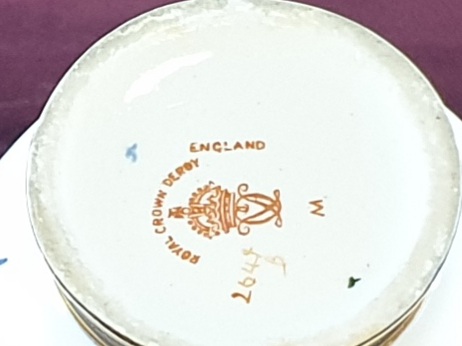
Royal Crown Derby is particularly associated with fine bone china, hand-painted decoration and the use of gold on selected patterns. Its Old Imari pattern, numbered 1128, is among its best-known designs. The company’s historical pattern books and backstamps can help identify and date surviving pieces, although marks need to be considered alongside the pattern, shape and style of decoration.
The company has undergone changes of ownership over the years. Steelite International acquired Royal Crown Derby in 2012, and the business was later privately acquired by Kevin Oakes. Royal Crown Derby continues to manufacture fine bone china in Derby, maintaining its long association with British porcelain production.
Sources
Royal Crown Derby, Our Heritage — Royal Crown Derby, Craftsmanship & Design — The Metropolitan Museum of Art, collection records for Crown Derby porcelain — Derbyshire Historic Environment Record, Royal Crown Derby Works, Osmaston Road, Derby
Patterns
- A
- B
- C
- D
- E
- F
- G
- H
- I
- J
- K
- L
- M
- N
- O
- P
- Q
- R
- S
- T
- U
- V
- W
- X
- Y
- Z