
About Schumann China
Schumann China was produced by the Schumann porcelain factory in Arzberg, Bavaria, Germany. The company’s porcelain-making history dates to 1881, when Porzellanfabrik Schumann & Riess was established by Christian Heinrich Schumann and businessman Franz Ferdinand Riess.
Following Christian Heinrich Schumann’s death in 1884, the business was managed by his widow, Christiana Schumann, on behalf of their son Carl. In 1892, when Carl reached the age of 21, the factory was renamed Porzellanfabrik Carl Schumann, and the business developed under his leadership.
The factory produced a wide range of domestic and decorative porcelain, including tea and dinner services, ornamental pieces and finely decorated tableware. It became particularly known for pierced, or reticulated, porcelain, in which sections of the porcelain were carefully cut away to create openwork designs. Floral decoration, gilding and detailed painted patterns were also features of its production.
Schumann porcelain was exported to international markets, including the United States. The name Schumann China Corporation was used in connection with the company’s American distribution, helping its porcelain reach customers overseas.
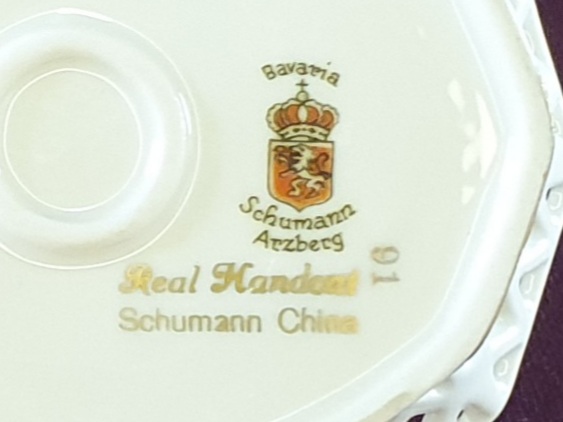
Surviving pieces may carry backstamps such as Schumann Bavaria, Schumann Arzberg Germany and variations incorporating the word China. These marks can help with identification, but their wording and design should be considered alongside the shape, pattern and decoration when estimating a piece’s date.
The factory continued production through much of the 20th century, employing a substantial workforce during its most successful period. However, changing market conditions and economic pressures affected the German porcelain industry, and the Schumann factory in Arzberg closed in 1994.
Schumann China includes many different patterns and styles, from everyday tableware to elaborate pierced porcelain and richly decorated ornamental pieces. Its factory marks and decorative details provide useful clues for researching individual examples.
Sources
The Old Stuff, Schumann Arzberg Marks — The Old Antiquarian, Schumann Arzberg Porcelain: Marks, Bavaria, Dating & Value — Museum Europäischer Keramikkunst, Schumann factory history — Porzellanstraße, Arzberg
Patterns
- A
- B
- C
- D
- E
- F
- G
- H
- I
- J
- K
- L
- M
- N
- O
- P
- Q
- R
- S
- T
- U
- V
- W
- X
- Y
- Z